Hidden Sparks – A Film Dialogue

A Retrospective of Menachem Daum’s Films

January 27-February 17, 2026, Fordham University at Lincoln Center

This retrospective is part of the series “On Disagreement in Jewish History”

Menachem Daum and Carrie Burns, Jerusalem 2012. Photo by Kamila Klauzińska

Menachem Daum, a child of survivors of the Holocaust, stumbled upon a family story in the Polish town of Działoszyce that would change the course of his life. His films explore his quest to find common ground between Jews and non-Jews, Orthodox Jews and secular Jews, Polish Catholics and Polish Jews, as well as between Palestinians and Holocaust Survivors. His Orthodox upbringing as a child of survivors born in a DP camp and brought up in Schenectady and mostly in New York City, and his early encounters at Brooklyn College with secular Jews, and, in New York, with Rabbi Shlomo Carlebach, led him on his first journey to Poland in the late 1980s. Carlebach’s outreach to the Polish people was in total contradiction to his experience with his own survivor community, who often had disdain for their former Polish neighbors. That experience inspired him to re-examine his own viewpoints and to embark on a lifelong search for a way to bridge the often insurmountable gaps between people. Equally central to Menachem’s lifelong search was seeking to understand his father’s faith after losing his wife and a child during the Holocaust at the hands of the Nazis. This search led to his exploration of the Hasidic Jewish community and its rebirth in the United States. For over twenty years, Menachem travelled repeatedly to Poland, seeking out “memory keepers,” Polish Catholics and Jews who sought to preserve Jewish memory and bring Jewish life and culture back to Poland, where it was decimated. 

Menachem Daum received his Ph.D. in educational psychology from Fordham University in 1978, with a dissertation on aging.

Tuesday, January 27, 2026, 5:30 PM: A Life Apart: Hasidism in America, 

A screening and discussion of the documentary, A Life Apart: Hasidism in America, the first in-depth documentary portrait of the daily life, beliefs, and history of contemporary Hasidic Jews in New York City, exploring conflicts, burdens, and rewards of the Hasidic way of life.

The post-screening discussion will include Professor Ayala Fader, filmmaker Oren Rudavsky, the film’s associate producer Marty Dornbaum, Menachem Daum’s wife Mrs. Rifke Daum, and Marcus Allison.

WATCH the discussion HERE.


Tuesday, February, 3, 2026, 5:30PM: Hiding and Seeking

A screening and discussion of Menachem Daum’s film Hiding and Seeking, an award-winning documentary which tells the dramatic and emotional story of Menachem Daum’s  journey with his two sons to Poland to try to find the Polish Christian farmers who hid their family from the Nazis. The film explores the Holocaust’s effect on faith in God and the faith in our fellow human beings. Without avoiding complexity, it juxtaposes the post-Holocaust image of Poland as an antisemitic country with the encounter with people who personify the highest levels of compassion.

The post-screening discussion will include historian Natalia Aleksiun, filmmaker Oren Rudavsky, Mrs. Rivka Daum, and Tzvi Dovid Daum.

WATCH the discussion HERE


Monday, February 9, 2026, 5:30 PM: The Ruins of Lifta, 

We are presenting the 2016 documentary about  the past and the present through the lens of Lifta, the only Arab village abandoned in the 1948 Arab-Israeli war that has not been completely destroyed or repopulated. Its ruins serve as a haunting backdrop for a confrontation between the two mega-narratives that underlie the Arab-Israeli conflict; the Nakba and the Holocaust.

The post-screening panel will include historian Mehnaz Afridi, legal scholar Aleksandra Gliszczyńska-Grabias, filmmaker Oren Rudavsky, Hillel Cohen, and producer Aaron Levitt.

REGISTER


Tuesday, February 10, 2026 at 11AM: A Conversation with Hillel Cohen about “The Ruins of Lifta” and Its Legacy Today

REGISTER


Tuesday, February 17, 2026, 5:30 PM: Memory Keepers, an unfinished film.

A screening of portions of Menachem Daum’s unfinished film and a conversation with Aleksandra Gliszczyńska-Grabias, Kamila Klauzińska, and Oren Rudavsky.

REGISTER

All events are possible through the generosity of The Knapp Family Foundation, The Picket Family Foundation, the Shvidler Gift Fund to Fordham University, Fordham Trustee Henry S. Miller, the members of the CJS Advisory Council and individual donations from friends of the Center for Jewish Studies at Fordham.

COVID-19 Series: Watching “Unorthodox” during COVID-19

The Beginnings and the Endings: Watching Unorthodox during COVID-19

By Jessica Lang, Professor and Chair of English and Newman Director of the Wasserman Jewish Studies Center, Baruch College, CUNY

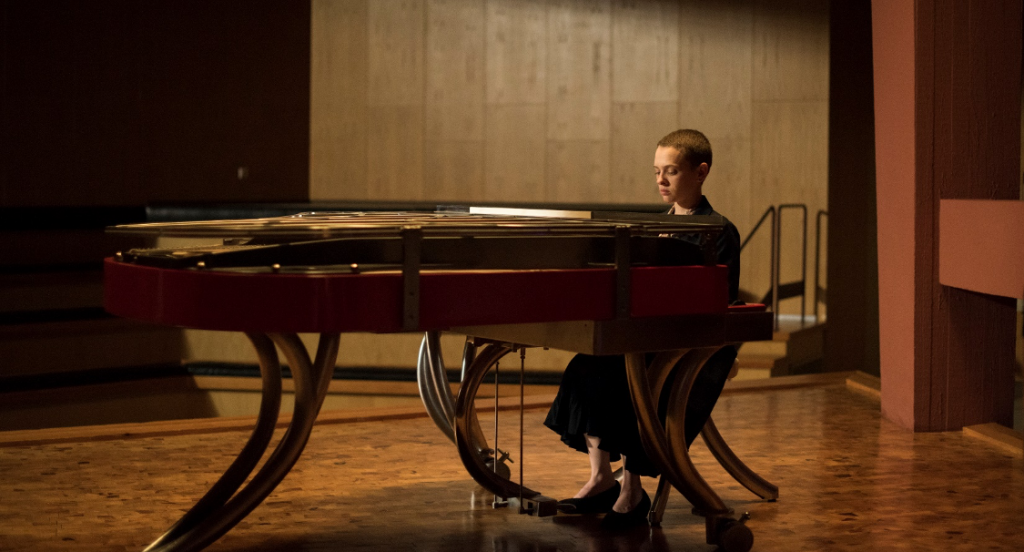
The Netflix four-part miniseries Unorthodox, loosely based on the 2012 memoir by Deborah Feldman by the same name, debuted on March 26, 2020, the same week that millions of Americans were impacted by stay-at-home orders for all but essential workers. Numerous media outlets reported that within the first weeks after its release, Unorthodox was among the platform’s most-viewed content. The word “quaranstreaming” was coined to capture viewer bingeing. Watching shows during a pandemic, especially newly released ones, emphasizes one of many practices that have become our new normal: a communal activity done in isolation from one another. We all watch together while we are apart.

Anika Molnar/Netflix

Unlike the book on which it is based, which unfolds in chronological order, the editing of Unorthodox holds viewers in a present, a recent past, and a more distant past, all of which are interwoven together, appearing and disappearing unexpectedly. Told this way, Unorthodox is a fractured story with multiple beginnings and endings, “befores” and “afters,” a feature that resonates even more when watching it in a COVID-19 landscape. Viewers move around not only in time but also in our relationship to the different representations of the main protagonist, Esty, with each beginning magnified because of its nonchronologic position.

We first see Esty as a married woman, who, childless, remains apart from other married women in her ultra-Orthodox community in Williamsburg. We see her next as a stranger in a strange city, Berlin. We then see her in an earlier period, as a girl who is, as she describes herself to the young man soon to become her husband, “different.” Raised by her grandparents with a mother who had, according to family lore, run away, and father who is a charpeh, a disgrace, Esty offers viewers glimpses of other beginnings that demarcate other pasts and fall outside the framing of the series.

The interplay between time, setting, and perspective is deliberately irregular and unpredictable, asking that viewers collect and connect the fragments they are given and create a narrative out of them. A delicate thread, created through music, holds these fragments together. In the first episode, as Esty seats herself on the steps outside her mother’s apartment building in Berlin, the opening strains of Schubert’s “An die Musik” are heard. The setting abruptly switches to an unmarried Esty setting the Shabbes table at her grandmother’s house, when a soprano’s voice starts singing what is perhaps Schubert’s best-known lied:

Du holde Kunst, in wieviel grauen Stunden, Wo mich des Lebens wilder Kreis umstrickt,         Hast du mein Herz zu warmer Lieb’ entzunden,    Hast mich in eine beßre Welt entrückt,     In eine beßre Welt entrückt!       O blessed art, how often in dark hours, When the savage ring of life tightens round me, Have you kindled warm love in my heart,
Have transported me to a better world! Transported to a better world

The song reappears towards the end of the last episode, only this time the singer is Esty, who, having applied for a scholarship to a music school in Berlin, chooses to audition with the song she heard in her grandmother’s home, the one her great-grandfather, with his own fine voice, loved to listen to in Hungary, before the war when “so viel vorloren,” so many were lost. The melody of the song is simple and clear, as is the meaning of its words: music, the champion of art, ignites warmth and light in times that are wretched, offering an alternative, however fleeting, to the darker world around us.

After they hear “An die Musik,” the judging panel asks Esty to sing another song, one better suited to her tonal range—“something different,” as one judge frames it, recalling the sense of difference that has long set Esty apart. Esty squares her shoulders, closes her eyes, and, with no formal practice, launches into another song heard earlier in the series. A number of male wedding guests sing “Mi Bon Siach” as Esty walks towards the chuppah at her wedding. In a reversal of that scene, as Esty begins the song in her audition, her abandoned husband enters the auditorium and hears her voice.

The One who knows the speech of a rose among thorns The love of a bride and the joy of lovers He will bless the groom And the bride.Mi bon siach shoshan chochim, Ahavas kallah, misos dodim,        Hu yevarech es hechassan V’es hakallah.    מי בן שיח שושן חוחים אהבת כלה, משוש דודים הוא יברך את החתן ואת הכלה

It’s possible for us to understand Esty’s singing of these two songs in the final episode as sacrilegious—that music for her is salvational as faith never could be. Moreover, Esty’s two solos at the end of Unorthodox can—and maybe should—be understood as a declaration of selfhood. As she takes the stage to sing she makes a vocal public pronouncement, one that is declarative and deliberate, and one that by her community’s estimation violates strictly enforced standards of modesty for women.

And yet the invocation of the elte zayde by Esty’s bubbe as the two listen to a soprano singing Schubert’s 1817 work, and Esty’s tribute to her grandmother—and moments later her husband—as she explains why she chose the song for her audition, connects generations, places, eras, and traditions. It weaves together the varied beginnings and endings, including Esty’s grandmother’s death and the birth of her child, and suggests that Esty’s rendition draws her in some ways closer to her past even as she launches herself into a new way of living.

Esty gives us a sense of what lies ahead—a mix of multiple pasts, presents, and possibilities, and the unequivocal need for the transformative capacity of art to create new understandings about ourselves in a world that in some ways will be permanently changed.


Jessica Lang is Professor and Chair of English and Newman Director of the Wasserman Jewish Studies Center, Baruch College, CUNY

COVID-19 Series: The Pandemic through Hasidic Women Artists’ Voices

by Jessica Roda, PhD, Georgetown University, Center for Jewish Civilization

Hasidic women are often portrayed in the mainstream media through a Western feminist framework, which assumes that women can only gain agency by leaving their faith. Two media events during  the COVID-19 crisis have reinforced this narrative:  The first is media coverage of the ultra-Orthodox response to the COVID-19 pandemic and its domination by male voices of rabbis, doctors, and male community leaders on various platforms, while women, such as journalist Efrat Finkel, are rendered invisible and unheard. The second event is the release of the Netflix drama Unorthodox, a miniseries based on Deborah Feldman’s 2012 memoir of the same name, which follows a hasidic woman named Esti, who can only end her suffering and shine as an artist by leaving her Brooklyn community for the secular, inclusive, multicultural, and artistic Berlin.

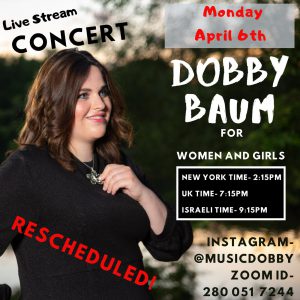
Dobby Baum, April 12, 2020, Concert-Talk on Zoom and Instagram 

Although the ultra-Orthodox are known for their opposition to the Internet, some hasidic business owners find it necessary to be connected. Other ultra-Orthodox Jews use technology by choice. Among them are Dobby Baum, Malky Media, Devorah Schwartz, Sarah Dukes, Bracha Jaffe, Devorah Leah, and Chany Rosengarten, each of whom I discovered online in the last two years. These women come from a mixed ultra-Orthodox background, representing Bobov, Chabad, Ger, Litvish, and Satmar communities. They are particularly active on Instagram, where they promote their businesses, music, films, lessons, performances, and albums. The application serves as a marketing tool and springboard to create a community of followers. Ultimately, their use of Instagram might lead to their broader recognition, and to a range of contracts for live private and community performances. Dobby, Malky, Chany, Sarah, Devorah S., , Bracha, and Devorah L. are each building a new image of Orthodox womanhood. Implicitly, they are creating a counterpublic space (Hirschkind 2006; Fader 2020) in response to a mainstream religious space.

My intention is never to diminish the suffering of OTDs (Off the Derech, people who left ultra-Orthodoxy) or to dismiss the lack of action from some religious leaders, yet I felt the need to give voice to the Hasidic women whom I had the privilege to meet in person during my fieldwork and whom I follow on Instagram every day. To demonstrate the oversimplification of hasidic women’s agency, I would like to call attention to contemporary ultra-Orthodox women artists’ responses to the COVID-19 crisis.

Because modesty is central to their way of being, the majority of their activities occur live among only women and girls. The artists were preparing to perform and screen their films during Passover, but found their income compromised by the coronavirus outbreak. Like many around the world during this challenging time, they must fulfill their raison d’être by boosting their online presence and creating new opportunities for artistic collaboration.

Dobby Baum, Live Concert on Zoom and Instagram, April 2020, Borough Park (NYC)

During the pandemic, viral videos have surfaced of neighbors singing from their balconies in Italy, Spain, and France; songs such as “The Coronavirus Rhapsody”; and diverse compositions urging us to stay home and wash our hands. Similarly, Orthodox female artists have provided creative responses to the crisis online. They continue their women-and-girls-only performances via live concerts on Instagram and Zoom, where hundreds of girls and women participate from around the world. Their notable releases include their first collaborative video, “A Song for Lori,” in honor of Lori Kaye, who was murdered in the Poway synagogue shooting. Dobby Baum’s “It Is Meant to Be,” a response to COVID-19, is also noteworthy. As evidenced by their concert-conferences on Zoom, they have used this moment to constantly engage with their online viewers about the pandemic and the importance (and challenges) of staying at home. With thousands of followers––and more to come––they are reinforcing a sense of community and sisterhood. Crucially, they are reinventing their religiosity by means of technology and media. In doing so, they challenge narratives that imagine them as silent members of their religious society.

Postcolonial feminist scholars, such as Saba Mahmood and Serene Khader, have argued that critiquing Western secular feminism is necessary to prevent the oversimplification of the concept and experience of agency. Their argument is certainly relevant when it comes to the realities of conservative groups and families. These aforementioned scholars impacted how I understood my observations during my fieldwork with hasidic women in Montreal and New York City, and how I understand the online activity of ultra-Orthodox women artists.

The girls and women of Unorthodox cannot openly pursue their artistic aspirations. Dobby, Malky, Chany, Sarah, Devorah S., Bracha, and Devorah L. present a challenge to the show’s characters, as they seek new avenues to reinforce their religious belonging while challenging it from the margins.  


Jessica Roda is an anthropologist and ethnomusicologist. She is currently an assistant professor of Jewish civilization at Georgetown University’s Walsh School of Foreign Service. She is working on her second book, Beyond the Shtetl: Hasidicness, Women’s Agency and Performances in the Digital Age, in which she investigates how artistic performances empower hasidic and former hasidic women to act as social, economic, and cultural agents. Jessica Roda was a fellow at Fordham in 2017.