Jewish Studies before Jewish Studies @Fordham: Interview with Professor Edward Bristow

This year, Fordham’s Center for Jewish Studies is celebrating its fifth anniversary.  But before the formal founding of the CJS, many professors, students, librarians, and others taught, studied, and cultivated the study of Jews, Judaism, and Jewish history and culture at Fordham.  This blog series features interviews with some of these people and celebrates their lasting contributions to the university.  

This interview features Professor Edward Bristow, Professor of History at Fordham, previous Dean of Fordham College at Lincoln Center, and Founder of the Fordham-Alvin Ailey BFA Program in Dance as well as the Annual Nostra Aetate Dialogue on Catholic-Jewish Relations.

Can you tell us a bit about yourself and your work?

I came to the then “College at Lincoln Center” in 1986 as associate dean after training at Yale, teaching in England for a wonderful decade, and turning to administration. Back in New York, grantmaking at the New York Council for the Humanities was enjoyable and instructive, and working in the ambitious central administration at NYU prepared me for anything that might  follow in university life. My first books were in British political and social history. Later I found my way to academic subjects of Jewish interest, a focus that was encouraged by the post-Vatican 2 philosemitic culture of a Jesuit university.

You joined the Fordham faculty many years ago.  What was Fordham like at that time and how has it changed since then?

Fordham was a far less complex institution in the 1980’s. It was not nearly as heavily administered nor as multifunctional as it is now. It was not unusual for administrators to have little to do in summer. My two predecessors as dean disappeared for much of the summer, leaving me to run the college. When I became dean in 1991 the college remained intergenerational, with easy crossover between day and evening sessions, and without a residence hall. We housed residential students at The Hotel Lucerne on 79th Street, later devoted to the homeless, or at any other facility that we could turn up. McMahon Hall opened on my watch. The college was organized on a divisional rather than a departmental basis, which encouraged interdisciplinary teaching and colleagueship across fields. The dean had considerable autonomy and was responsible for a range of campus programs, including HEOP [Fordham’s Higher Education Opportunity Program], College at Sixty, and ESL [English as a Second Language], which we planned and initiated. For a time we ran evening admissions and struggled to stabilize the shrinking size of our nontraditional student intake. We went so far as to advertise on WFAN radio, not a popular move with the administration, though now Fordham advertises on New York Giants radio broadcasts.

Fordham was not yet focused on developing our arts curriculum. Theatre was in place but suffered as it still does from inadequate performance space. Music instruction barely existed. At the last minute I had to find money from discretionary funds for providing a critical window in a new arts studio which had somehow been left out of the architect’s plan. Otherwise there would have been no natural light for painting.  With no funds centrally available, we also paid for the portable banked seating in the auditorium which is still in use, as well as for the first white-box rehearsal space, built on the sly with the help of a sympathetic Lincoln Center administrator. Our primary initiative was the collaborative BFA dance program with the Ailey School, launched in 1998 following several years of planning.

In the 1990’s, the central administration decided to restructure undergraduate education, placing the day and evening sessions in separate schools, repurposing the new Fordham College at Lincoln Center as a largely residential day college for traditional students, and uniting the two college faculties in bi-campus departments. This enabled a range of important academic enhancements, and was necessary to permit us to compete successfully in the admissions marketplace.
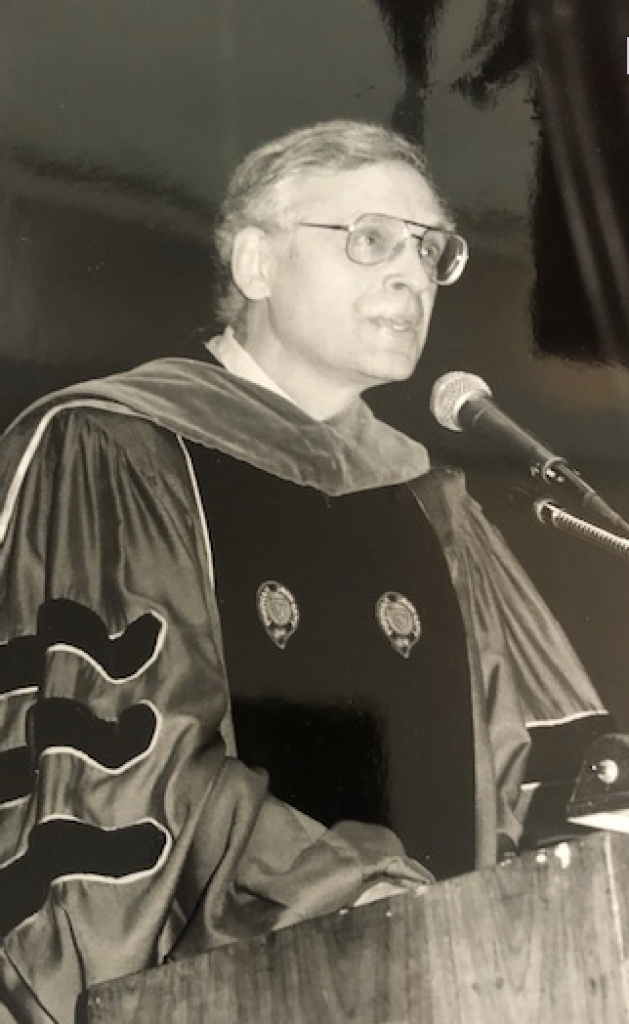
Edward Bristow as Dean of Fordham College at Lincoln Center

When you were Dean of Fordham College at Lincoln Center in the 1990s, you initiated an annual interfaith dialogue, which eventually came to be published as a book titled No Religion Is An Island: The Nostra Aetate Dialogues.  What inspired you to begin Catholic-Jewish dialogue on campus, and what did you learn through that experience?  

I recall the moment when the Nostra Aetate Dialogues came to mind. It was at Elie Wiesel’s honorary Fordham degree ceremony at Rose Hill.  Wiesel observed that Fordham would never have invited his father to such an event, and that his father would never have accepted. His comment encapsulated how Nostra Aetate marked an unparalleled religious transformation. Times had changed, good interfaith relations were palpable, and interreligious dialogue was developing across the country. I approached the late president, Fr. Joseph A. O’Hare, who eagerly encouraged me to develop the program.

Archbishop Timothy M. Dolan, Arnold Eisen (seventh chancellor of the Jewish Theological Seminary), and Edward Bristow speak at the Nostra Aetate Dialogue in November 2009

Is there a particular conversation or moment from the dialogues you hosted that stands out in your memory?

Several moments from the dialogues are especially memorable. We promoted the programs widely and aggressively, always essential in New York with its broad public offerings. When we entered the Law School auditorium for the inaugural program in 1993 on “The Jewishness of Jesus,” there were scores of people sitting in aisles, with hundreds more unable to gain admission. This was far more pleasing than Cardinal O’Connor’s entrance to the Pope auditorium a few years later, where he could barely reach the stage and had to climb over scenery set up for a theatrical production.

​​Our dialogue in 2000 concerned the role of Pope Pius XII during the Holocaust, a controversy that was raging at the time. An international commission of six distinguished Catholic and Jewish scholars was studying the subject and was about to break up in recrimination.  We invited Fr. Gerald Fogarty SJ, who had been in my graduate-school class, and who was serving on that international commission. He told the audience that no smoking gun would be found when the wartime papers of Pius XII were finally opened. This turned out to be right.

When the storm over Pius XII was first raised in 1963 by Rolf Hochuth’s sensational and wildly tendentious  play, “The Deputy,” the Vatican enlisted Jesuit editors to publish what became a twelve-volume set of Pius’s carefully selected wartime correspondence. The later international commission asked that some obvious and important gaps in the published correspondence be filled in from the archives. It was the Vatican’s refusal to provide this documentation that caused the breakup of the commission. The pope’s wartime papers were finally opened in 2020, and we now have the initial findings, including a major work by David Kertzer. His virtual day-to-day narrative has not really turned up a smoking gun. What could that look like? Nor does Kertzer appear to fill in most of the gaps identified by the commission, for which documentation must not be extant. On the other hand, his account of the Pope’s wartime activities provides a shockingly awful record of moral and political failure.

Among your research interests is the study of comparative genocide, antisemitism, and the Jewish anti-slavery movement.  Can you tell us a bit about your work in these fields?

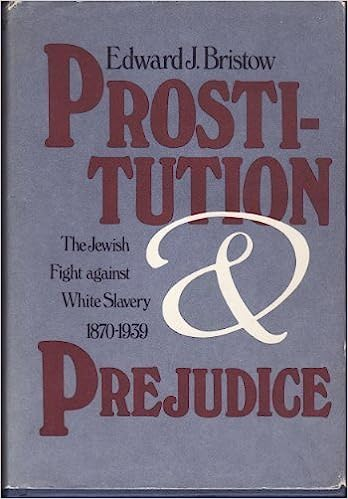
While researching an earlier book about social-purity movements in English history,  I encountered documents about the Jewish role in the international white-slave traffic from the late-nineteenth century to 1939. This development seemed so unusual that I resolved to explain how it could have emerged. The result was Prostitution and Prejudice (1982). Chillul Hashem? Jewish historians still comment about how difficult it is to acknowledge the disproportionate role of Jews on the revolutionary left, which did indeed fuel antisemitism. I proceeded with the book because we also understand that the danger is not generally what Jews did or do, but what they permanently represent in Western culture. Gaining access to Jewish archives was sometimes a problem. I later learned that some papers may have been kept from me at the Hebrew University archives. Officials at the Jewish Colonization Association in London, whose collection relating to Jewish settlement in Argentina was central to the subject, tried to convince me to abandon the project. In the end JCA settled for control of the book’s title, but compromised with my editor at Oxford University Press by settling for the subtitle accentuating Kiddush Hashem: The Jewish Fight Against White Slavery.
You teach a course about the Holocaust.  When did you begin teaching this course and what are the themes you emphasize in this course?

A course about the Holocaust was a natural development at Fordham in the post-Nostra Aetate years, and I first offered it in 1988.  A thread within the course, if not an emphasis, is the Holocaust as a laboratory for human behavior in extreme situations, affecting everyone involved across the range of roles. For example, there is now sufficient work in social psychology, evolutionary psychology and neuroscience for us to go beyond Christopher Browning’s use of the famous Milgram and Zimbardo experiments. Rescue remains a puzzle, defying general theorizing. In addition to the conventional emphases, I deal thoroughly with the role of the churches, especially the Catholic church. To address the difficult question of how we may effectively represent the Holocaust, I assign Primo Levi’s Survival in Auschwitz, and short sections of Claude Lanzmann’s “Shoah”. I leave time for the important aftermath, including the  development of international humanitarian law, retributive justice and its failures, and the long-term cultural transformation which uniquely produced German identification with their victims rather than with the perpetrators. The class visit by Mr. Martin Spett, a remarkable survivor, was always transformational. His recent death moves us closer to the day when there will be no survivors.   

Teaching the course at the Juilliard School in Fall 2022 afforded the opportunity to consider the odd tension between barbarism and high culture that characterized the Nazi regime. Martin Goldsmith visited the class. He is a writer and classical music presenter whose parents, until their last-minute escape in 1941, played in the Jewish orchestra that was organized by the heroic Kulturbund and permitted by the Nazis as a useful propaganda tool. Martin’s  grandfather and uncle sailed on the ill-fated SS St. Louis and perished at Auschwitz. His long quest to reconstruct this family saga and put to rest second-generation difficulties produced two family histories and a docudrama with the famous Bruno Ganz in his last role cast as Martin’s father (Ganz played Hitler in “Downfall”). The course concluded with a look at the denazification hearing of Wilhelm Furtwangler, one of the greatest conductors of the twentieth century, and who played for Hitler. I hope to bring Martin to Fordham in Fall 2023. 

A course on Genocide was a natural outgrowth of the Holocaust course. I used to assign reading about whether the Holocaust was unique, a topic that thankfully is now largely ignored. This made me curious about other mass atrocities, which is what the Genocide course is about.  Carefully arranged comparative study enables us to understand individual cases more clearly, and the several weeks devoted to the Holocaust in the Genocide course usually produce further curiosity.

You also established the Fordham-Alvin Ailey BFA program in Dance.  What are some intersections between your research or teaching on topics related to Judaism, and the study and practice of dance?

The BFA Dance program is a consequence of our proximity with the Ailey School, and our mutual location at the center of the performing-arts world. The scores of professional dancers from City Ballet who studied at Fordham beginning in the 1980’s also encouraged us, since most of these performers were excellent students, knew how to learn, and were loved by faculty. Dance is not alien in the history of the Jesuits, who were actively involved with liturgical ballet in seventeenth-century Paris. From the beginning Jesuits engaged our dancers to perform a piece at Fordham’s annual Christmas concert. It surely helped that Fr O’Hare was a devoted fan of Judith Jamison, Alvin Ailey’s muse.

Edward Bristow with Melanie Person (Co-Director, The Ailey School) and Laura Auricchio (Dean, Fordham College at Lincoln Center) at a Fordham-Alvin Ailey BFA Benefit

I was surprised and interested when Robert Battle, Jamison’s successor as the Ailey Company’s artistic director, made a ballet about the Holocaust using a score by Erwin Schulhoff,  a Czech-Jewish composer who was killed during the war. Battle calls the ballet “No Longer Silent,” referring to the many talented interwar composers who perished. BFA alumni in the Ailey company have performed in this piece. Battle, who has an honorary Fordham degree, has commented sensibly that he could only approach the theme indirectly, not fully programmatically.

Thank you, Professor Bristow, for sharing this amazing personal and institutional history with us!
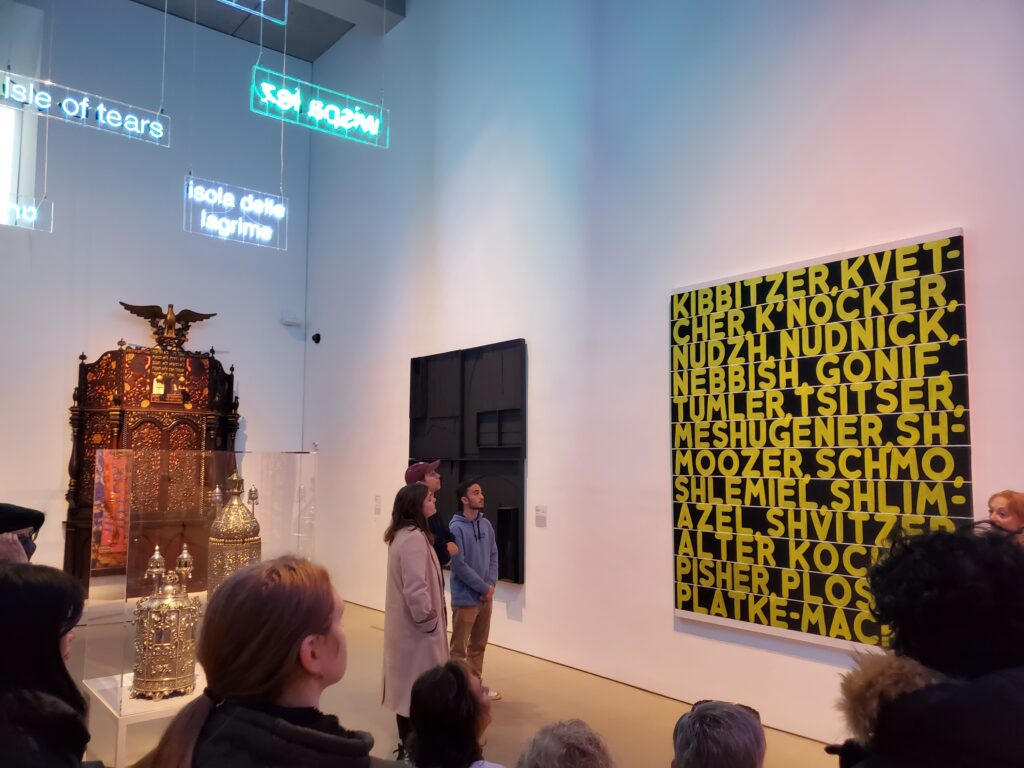
A Holistic View at Jewish Culture: Reflections on the Jewish Museum

Emma Reynolds FCRH’23

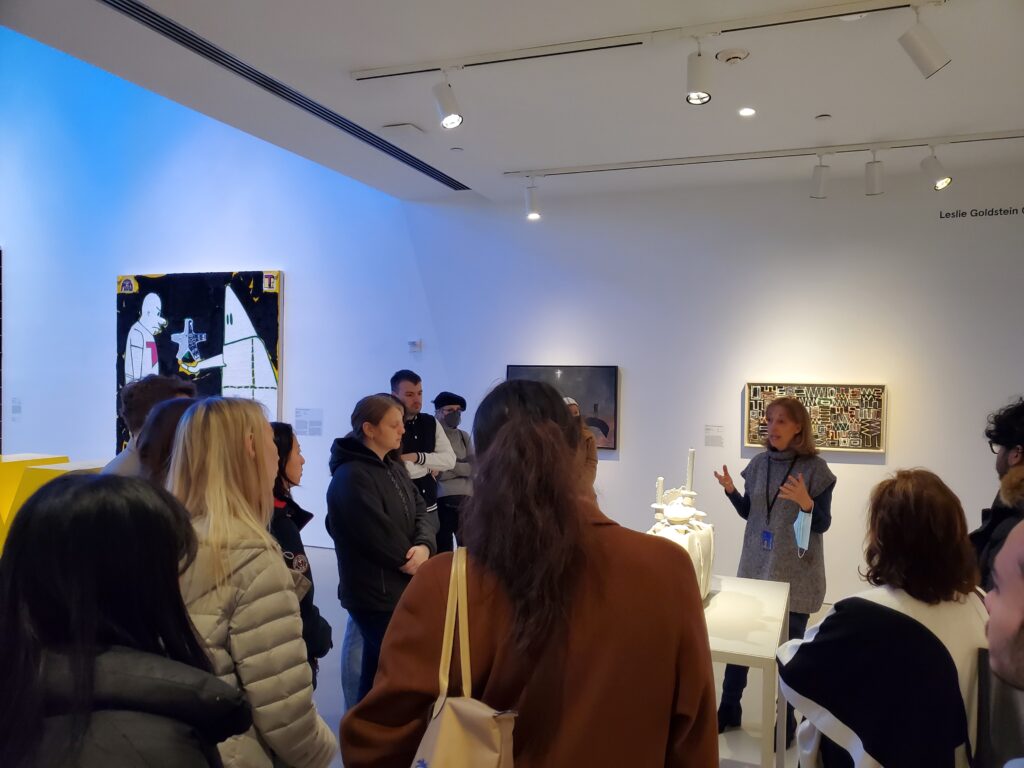
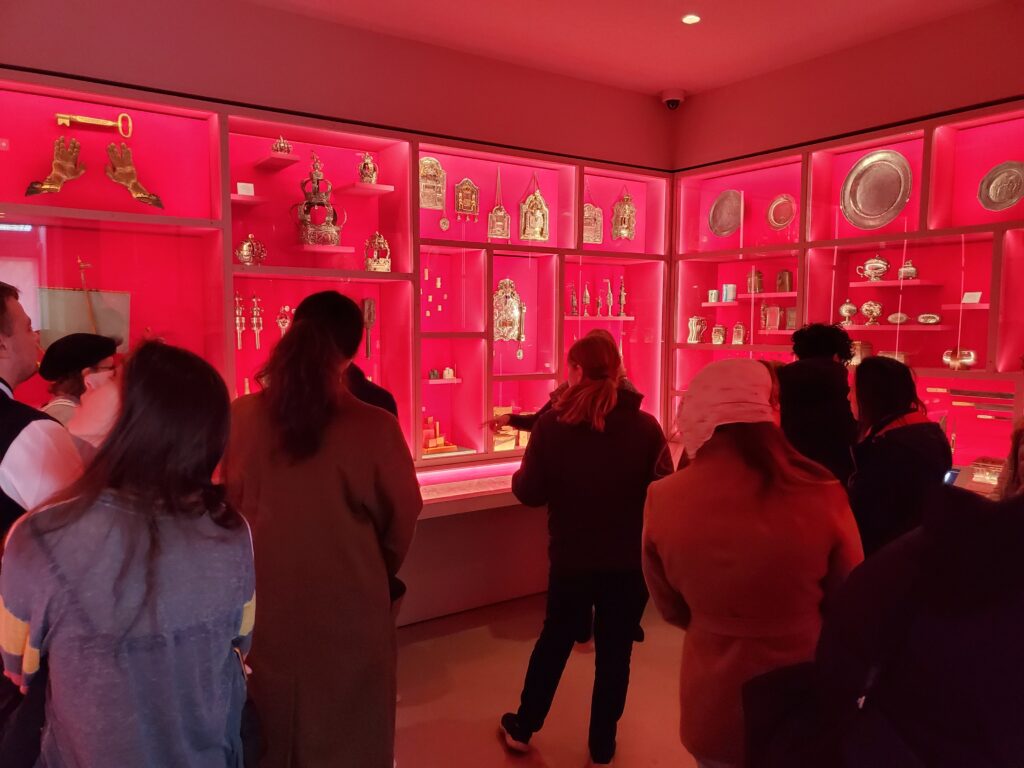
Immediately upon entering the Jewish Museum, the tone is clear: Holistic. On the third floor, the large main room we entered first was bright. It included art of all content and style, spanning centuries of history. The exhibit “Scenes from the Collection” was very obviously curated with a labor of adoration, with each piece in its specific place working with each piece around it to create a picture of Jewish culture that was both historical and personal, modern and contextual, saddening and rejoicing. I believe the museum was very careful to present Jewish culture as alive, not simply reduced to Jews as victims of tragedy and discrimination. This was a theme I often came back to in our course this semester, how both antisemitism and the study of antisemitism can de-personify Jews, either turning them into villains or perpetual victims. The reinstating of Jewish personhood and identity, while also acknowledging the sadness and loss that is a part of that identity, is one of the strongest statements of the museum.

These themes of connecting personal modern identity with the past was shown through many pieces and displays in the exhibit. The first collection we viewed was a case of at least a dozen Hanukkah lamps that varied wildly. From material to sentimental context, from a century to a continent, each lamp was different and reflected the personality of Jews all across place and time, united by a culture and religion. The image was so powerful. These lamps were so personal, almost a vignette or a biography of a family who had once owned it, yet the display also served to point out the longevity of the traditions that maintained this culture. Too often in the study of Jewish history, or even more so in antisemitism, the lack of a Jewish voice can prevent us from seeing a person behind every story, perpetuated myth, act of violence or gaining of citizenship. While studying the history of antisemitism, I would constantly and actively remind myself to read between the lines and remember the humanity behind every story and remember that people, demonized in these text, were also not just victims—they had full and culture-filled lives that were enriched by their community and religion. This display of Hanukkah lamps also noted the connection between religion and culture.

Another display that stuck with me was the pairing of the highly decorated portrait of Alios Itzhak by Kehinde Wiley and the Torah ark made by Abraham Shulkin next to it. The placement of these two objects, different in era, form and function, allowed us as the audience to clearly compare and understand the elements that are reformed and replicated as important motifs in Jewish art. The similarities included religious elements such as the top more decoration of the eagle and the hands gesturing in prayer, as well as intricate detail work of flowers and vines. The overlap in these pieces that are so different really emphasize the importance of history to modern Jewish art and show how modern Jews continue to root themselves in their past and in religious origins to maintain a cohesive culture. The use of religious motifs despite the nonreligious function of the piece really speaks to the importance of the religion on the culture, yet the continuation of artistic styles also supports the reverse- that there is a deeper culture and style that unites beyond religious symbolism.

These ideas are also reflective of what we discussed in class, the variation in defining what is “Jewish”, and how its ties to cultural, religious, and ethnic roots impact the contextualization of Jews in their world. While this is relevant to antisemitism, as it concerns outward perceptions of Jews and what it means to be a Jew, these are also concerns of the self and of self-identity. In the art by modern Jewish artists, physical manifestation of that self-exploration is seen in their playing with the overlap of culture and religion. In the painting by Kehinde Wiley, I think this relationship is captured perfectly, and it is aided by the side-by-side comparison to the historical Torah ark.

The art on display did not shy away from discussions of trauma and violence, however, it framed these events in the context of Jewish agency and personhood. Works we saw explored

Jewish reactions to the mass murder or attempts to understand a new reality with the knowledge of the extent of anti-Jewish hate, but they did not reduce the Jewish people to faceless victims. This reflection on the real emotion and reaction to tragedy were some of the most honest and human works of art I’ve experienced. By framing the Holocaust in this way, almost in an abstract, the viewer is allowed to focus on the humanity of the artist, and the life that they created from a tragedy.

Overall, I think this museum is remarkably well conceived and unique in its ability to remain cohesive and yet represent such a long and diasporic history. In the use of the specific works of art to contextualize each other historically or emotively, the museum was able to create a truly personable and holistic view at Jewish culture.


Emma Reynolds is a senior at Fordham College at Rose Hill. She visited the Jewish Museum as part of the values seminar on the history of antisemitism taught by Professor Magda Teter in the fall of 2022.

Reflections on the Exhibit “Confronting Hate: Antisemitism, Racism, and the Resistance”

by Dylan Shack FCRH’23

Visiting the exhibit “Confronting Hate: Antisemitism, Racism, and the Resistance” in the Walsh Family library was an eye-opening experience in demonstrating the similarities between antisemitism and racism. The exhibit shows how both forms of hatred and their propagators have used similar methods to otherize Jews and African Americans. In both the United States and Europe, derogatory depictions of Jews and Black individuals were widespread in different forms of media consumed by the majority, Christian and white, from cradle to grave. This included storybooks that portrayed both Black Americans and Jews with exaggerated facial features, which were particularly used to caricature and dehumanize them.

Children's books play a role in perpetuating and fighting derogatory stereotypes: displayed here series of children's books from 1905, a 1949 edition of "Little Black Sambo," and Julius Lester's anti-racist reinterpretation of "Little Black Sambo": the 1996 "Sam and the Tigers"
Children’s books play a role in perpetuating and fighting derogatory stereotypes: displayed here series of children’s books from 1905, a 1949 edition of “Little Black Sambo,” and Julius Lester’s anti-racist reinterpretation of “Little Black Sambo”: the 1996 “Sam and the Tigers”

Seeing them on the screen in class was upsetting enough but seeing these items physically and knowing that they were distributed widely, that people made money off this hate, and that millions purchased these items willingly was a stomach-turning experience. These depictions and dehumanization, over centuries, resulted in the enslavement, torture, and mass murder of both peoples, though contexts for these persecutions differed. Pogroms committed in Europe even before the Holocaust against Jews and lynchings committed across the United States against Black people show the consequences of hatred and dehumanization.

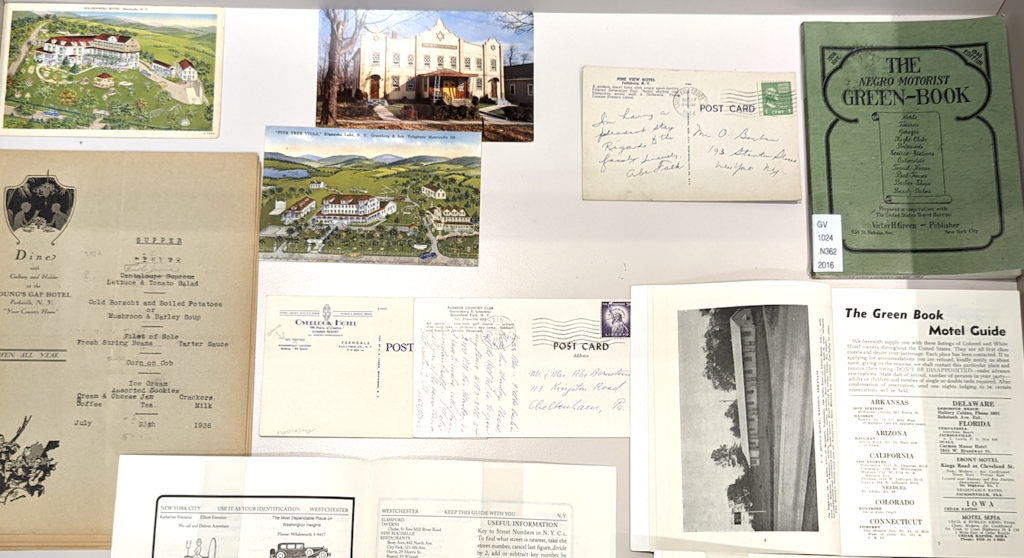
Another aspect I found interesting is that both Jews and Black people came together in these times of elevated discrimination and hatred in order to establish both guides and physical places where they could enjoy themselves without fear of discrimination. I knew of both the Motorist Green Book for Black community and the resorts which were open to Jews in such places as the Catskills prior to visiting the exhibit but had never independently made the connection of the level of similarity between these two in the creative ways in which they made the best they could while facing particularly dire discrimination nationwide.

The case displays a menu and promotional postcards of Jewish resorts in the Catskills and facsimile editions of the Green Book.

I think that this exhibition is also more relevant than ever in our current time as we have seen an increase in the level of both antisemitic and anti-Black racism nationwide, as well as a concerted effort by white supremacists to separate our two communities and define our struggles to obtain equal rights and treatment in our country as entirely separate issues. White supremacists know that the only way in which they can achieve power is to divide minority groups and pit us against each other. The reality is that our respective communities did have unique struggles. This is especially true of the degree of discrimination that Blacks faced in the United States, which was much more severe on average, in legal and experiential way, than Jews such as my family faced.

It is important as a point of mutual respect that I acknowledge this historical reality while also acknowledging that my family came to the United States to escape often comparably severe hatred and persecution Jews faced in Europe. Still as immigrants from Europe, my family was allowed to integrate into and benefit from white America, which was and still is a society that persecutes and discriminates against Blackness. This is something that I acknowledge while also understanding that Jews in America continue to face the threat of daily antisemitic violence. These realities which both of our communities have lived through and continue to live through are not mutually exclusive and acknowledging them can help us to work through much of the divide that white supremacists have sought to establish between our communities. This exhibit shows in painstaking detail the ways in which both communities have been dehumanized and othered are very similar, and the danger that these forms of hatred continue to present to society. The exhibit also shows resilience and ways to confront this hatred. I am grateful to have visited this exhibit and seen this intersectional struggle that our communities have experienced.


Dylan Shack is a senior Economics major at Fordham College at Rose Hill. He is taking a values seminar on antisemitism with Professor Magda Teter.

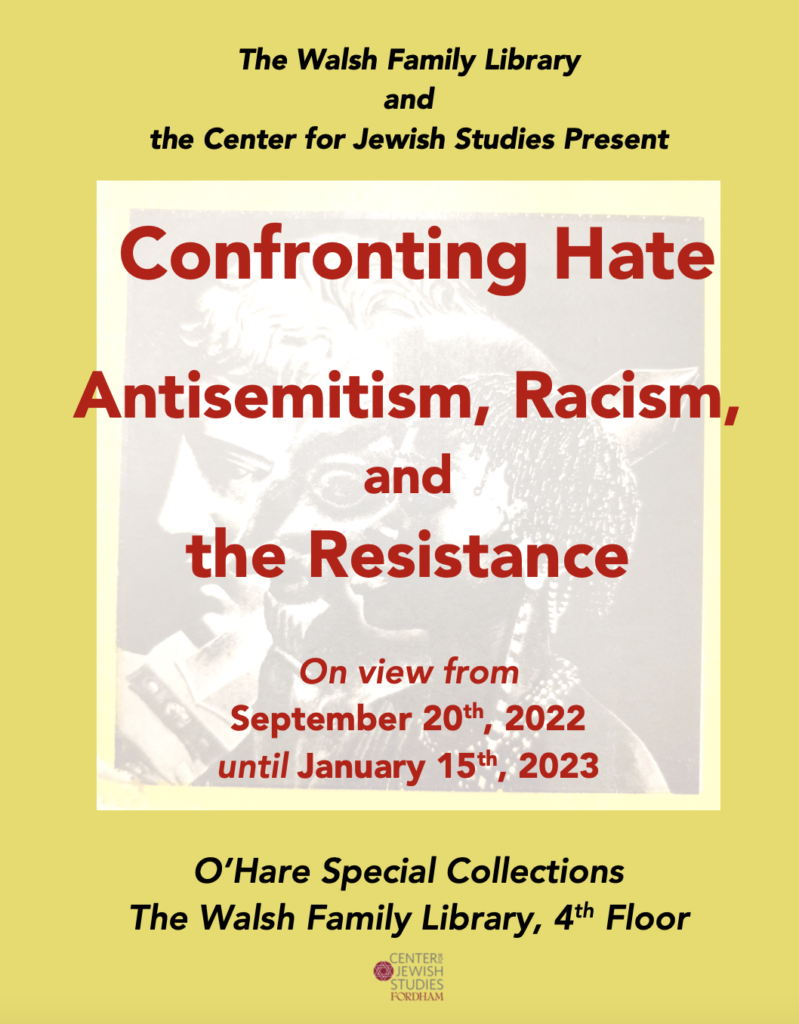
The exhibit “Confronting Hate: Antisemitism, Racism, and the Resistance” is on view at the Walsh Family Library until February 28, 2023, workdays 9:30AM-4:30PM. The exhibit catalogue is available here.

An Exhibit “Confronting Hate: Antisemitism, Racism, and the Resistance”

Westenley Alcenat, Lesley East, and Magda Teter

Antisemitism and anti-Black racism have often been viewed as separate issues. The exhibit “Confronting Hate: Racism, Antisemitism, and The Resistance,” a fruit of the work of students in HIST 4312: Antisemitism and Racism taught by Professors Westenley Alcenat and Magda Teter in 2021-2022, seeks to open a conversation about historical and phenomenological connections between racism and antisemitism. The exhibit highlights the way popular culture, scholarly works, and art have served to construct ideas about race and racial identity. It explores how racist ideas became entrenched in European and American cultures and how Jews, Black people, and their allies strove to push back. Premodern works displayed here illustrate the process of construction of racist and antisemitic ideas through rhetoric and imagery. More recent works, in turn, show how these ideas have left residual ramifications, continuously influencing future generations.

New Exhibit: “Confronting Hate: Antisemitism, Racism and the Resistance,” co-curated by Westenley Alcenat (History), Lesley East FCRH’24, and Magda Teter (History)

These anti-Black and anti-Jewish imagery and ideas were meant to promote hierarchical frameworks to reinforce Black and Jewish inferiority and the idea that the presence of Jews and Black people presents a danger to the dominant Christian—in case of Jews—and white—in case of Black people—society. Dehumanization and demonization became a function of social subjugation and exclusion. With relentless dissemination of these ideas, these anti-Jewish and anti-Black stereotypes and prejudices have been normalized and naturalized, influencing the conscious and subconscious perceptions of Jews and Black people, especially in Europe and in the United States.

This normalization and naturalization of racist and antisemitic rhetoric have not gone unchallenged. The main voices seeking to combat the anti-Black and anti-Jewish narratives in society came from the Jewish and Black communities—that is those most affected by their harmful effects. But there were some allies within the dominant society who used their more privileged platforms to push back against antisemitism, racism, or polices that were constructed by anti-Jewish and anti-Black ideologies. Alongside the historical sources demonstrating how these pernicious ideas became part of the cultural mainstream, the exhibit spotlights those men and women who spoke up against them. From the seventeenth-century Jewish and Christian writers defending Jews from deadly libels, to voices challenging Enlightenment scholars producing racist and antisemitic literatures under the guise of rationalism and science, to modern Black and Jewish scholars who turned to historical scholarship to offer new perspectives on dominant history, to ordinary Jews and Black Americans who, in spite of the odds, created spaces of luxury and travel that affirmed their dignity as citizens. The exhibit also highlights the ways in which Black and Jewish writers of children’s books harnessed the power of early education to push back against antisemitism and racism.

By exploring why racist and antisemitic ideas exist and how they continue to persist in modern ideologies and cultures, this exhibit hopes to open up a conversation toward mitigating their pernicious effects today.


The curators of the exhibit–Westenley Alcenat, Lesley East, and Magda Teter–are grateful to Fordham University’s Walsh Family Library and especially the O’Hare Special Collections for their support. We are especially grateful to Linda Loschiavo, the Director of the Walsh Family Library, and Gabriella DiMeglio and Vivian Shen at the O’Hare Special Collection. Vivian Shen set up the exhibit with great care and attention to detail.

The catalogue of the exhibit is available here.

And the video walk-through can be viewed here:


Westenley Alcenat is Assistant Professor of History and of African American Studies; Lesley East is a junior at Fordham College at Rose Hill, majoring in International Studies and minoring in Peace and Justice Studies; Magda Teter is Professor of History and the Shvidler Chair in Judaic Studies.